Introduction
For many aspiring healthcare professionals, the question is not if they want to enter the medical field, but how they can get started. Long-standing routes such as registering as a nurse or being admitted to medical school take years of study, a great deal of money, and competitiveness. This makes phlebotomy career a perfect option for those who want to enter the health professional career field quickly but still desire a long-term career with work growth.

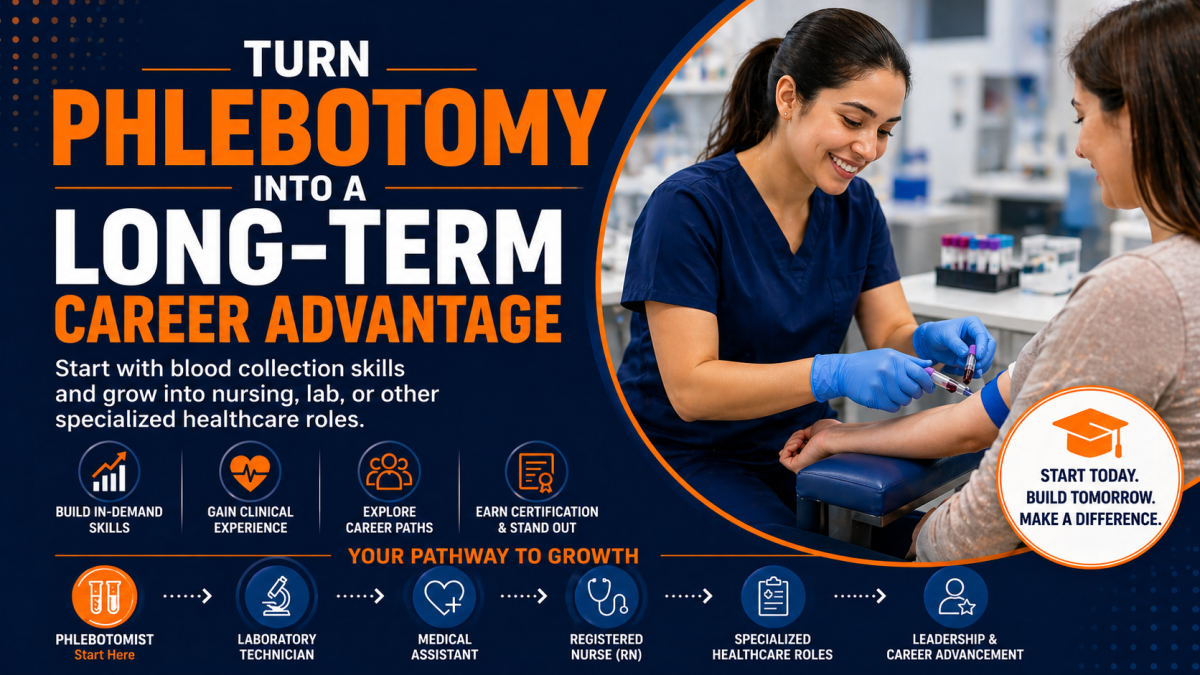
Phlebotomy gives a person the ability, perhaps, to work in the health care field within a year, depending on what training he or she can take that lasts several months. Once certified, employment can be obtained at large hospitals, diagnostic laboratories, blood banks, and state-of-the-art clinics, giving the technician first-hand exposure to medical care and the health care system. But one must not look at phlebotomy as an end in itself. Toward their better future, many people see phlebotomy as merely a footpath onto higher-level health positions, such as nursing, laboratory technology, and so forth.
Certified Phlebotomy Technicians (CPTs) hone their art in both technical and customer-related skills to advance into more advanced healthcare careers as well. The transition from phlebotomy to nursing or from phlebotomy to medical assistant is therefore very natural because of the basic skill-set laid down in this discipline being highly complementary to that required in higher professions.
If you are starting your own work life, contemplating a phlebotomy career advancement, or maybe pursuing a career-seeking phlebotomy option, this blog will attempt to reveal ways to translate phlebotomy into being a cornerstone for a full and prosperous future in health care.
Are you ready to get the ball rolling? Check out some phlebotomy positions on our portal today!
The Skills You’ll Master
Perhaps the major draw of choosing phlebotomy as your entry into the healthcare field is the wide array of skills one learns. While your primary role will be collecting blood, the job in itself is quite complex and offers tremendous preparation for various healthcare settings.
Technical Skills
Phlebotomy imparts precision and accuracy-discipline required in all branches of medical care. You will learn:
- Drawing blood through venipuncture, capillary puncture, or heel stick methods.
- Labelling specimens accurately and handling them properly for delivery to the laboratory so that appropriate testing can be done.
- Maintain universal precautions to infection control standards.
- Ensure equipment is disinfected and safe to use.
These technical practices overlap very much with those expected of a nurse, lab technician, and other healthcare professionals.
Patient Care Skills
Having been one of the first points of interaction, you learn to:
- Calm patients anxious about blood draws.
- Speak clearly about the procedure.
- Establish a quick rapport, even when pressured.
These patient care skills allow one to enter domains such as the nursing field, wherein communicating and empathizing are just as important as having technical clinical knowledge.
Time Management and Efficiency
In busy hospitals or blood donation centers, phlebotomists often have to juggle several patients all within a strict time frame. Developing such time management skills will see you thrive in high-stress situations skill that is highly appreciated in health careers.
Attention to Detail
Mislabeled samples or mishandled specimens could lead to a catastrophe. Your phlebotomy training hones your attention to detail, which directly spills back into lab work, nursing documentation, and patient charting.
Working and Collaborating
Phlebotomists do not work alone; coordination is made with nurses, lab staff, and doctors, allowing one to develop the skill of working within a health-care team. Exposure of this nature cannot be bought and is essential during transitions into cross-department collaborative roles.
In brief, the skills honed in phlebotomy foster a complete professional toolkit, allowing one to perform at the top of one’s abilities in current employment while simultaneously opening advanced jobs through phlebotomy career advancement.
Career Pathway 1: Phlebotomist to Nurse
The most common of all career transitions: that is, converting from phlebotomy to nursing. Nurses bear heavier responsibilities with a higher dollar amount attached to their services; they also have higher career flexibility. Many nurses start out as phlebotomists because the on-the-job experience gives them the confidence and insight into choosing a patient-care career.
How Phlebotomy Helps the Future Nurse
- Early Exposure to Patient Care: You will already have made acquaintance with patients through patient care, understanding the fears they suffered, and how to allay those fears.
- Hands-on Clinical Experience: Phlebotomists become skilled at using needles, specimen collection, and interfacing with patients-procedures that are fundamental to nursing.
- Networking in Health Settings: While working as a phlebotomist, you will meet nurses and supervisors who may be there for you to mentor you or guide you in your choice to enter nursing school.
- Confidence in Clinical Settings: Walking into nursing school with prior hospital or clinic experience reduces stress and helps adaptation faster.
The Path from CPT to RN
- Complete Prerequisites: Most community colleges and universities allow phlebotomists to complete their pre-nursing coursework while working.
- Applying to Nursing School: Your background as a phlebotomist gives your application more weight since prior healthcare experience is valued by the admissions committees.
- Choose your Path:
- Licensed Practical Nurse (LPN): Usually takes about a year to complete.
- Registered Nurse (RN): Two years for an associate degree, or four for a bachelor’s degree.
- Advanced Practice: Most nurses pursue their Master’s and Doctorate degrees later in life.
- Complete the NCLEX Exam: Once you complete it, this test will grant you your license to practice as a nurse.
Real-World Example
Let us think of a phlebotomist working in a busy hospital. As time goes by, they start developing an interest in patient monitoring, administration of IVs, and direct care. In case you get an Associate Degree in Nursing (ADN), you become an RN, and the proficiency you may have with patient care and drawing blood might be an additional plus.
Transitioning from phlebotomy to nursing profession is quite real and quite practical. Your phlebotomy background eases the school experience and instills confidence within the nursing arena.
Career Path 2: Transitioning From Phlebotomist to Lab Technician
If you enjoy science, analysis, and diagnostic areas of work, the transition from a phlebotomist to a lab technician career could be a good fit for you. As a phlebotomist, you already collect specimens, observe safety protocols, and interact with labs daily, making the next step both logical and achievable.
How Phlebotomy Prepares You for Lab Work
- You already know specimen handling and labeling protocols.
- You have observed lab workflows and appreciate the discipline required for accuracy.
- You have complied with quality control processes to decrease errors.
- You have experience with technology and medical equipment
Steps to Become a Lab Technician
- You will need to enroll in a Medical Laboratory Technician Program. Typically, for two years, this will be an associate degree.
- You might consider advancing to a Bachelor’s Degree. The higher the education level, the more eligible the position of a medical lab scientist will be.
- Pursue as many certifications as possible. The certification from the American Society for Clinical Pathology is well respected among professionals.
- If you want to, you can work in-between lab professionals. They could either go a microbiology, a hematology, or even a clinical chemistry route?
Salary and Job Outlook
According to the U.S. Bureau of Labor Statistics, the median annual wage of medical laboratory technicians was around $57,000 in 2023, with a growth rate of about 7% expected over the next decade. Thus, it proves to be a steady and rewarding career for those choosing to move over from phlebotomy.
Moving from phlebotomy toward a technician career allows one to go from a patient-facing role into the scientific realm of healthcare. Indeed, the change may appeal to those who enjoy diagnostics and research.
Phlebotomy as a career change
Not everyone starts their foray into healthcare right after school. Many choose phlebotomy as a career change after working in another career.
Why Career Changers Choose Phlebotomy
- Fast Entry into Healthcare: Most phlebotomy programs are less than one year, in which you can enter the workforce earlier.
- Affordable Training: Phlebotomy training is much cheaper compared to nursing or medical training.
- Profession in Demand: With hospitals, laboratories, and blood banks constantly on the lookout for good phlebotomists, job security remains strong.
- Growth Gateway: If you start from phlebotomy, though, it does not have to be your endpoint. It is a good springboard for further development.
Example of a Career Changer
For a retail worker in their 30s, achieving a more stable and meaningful career may be a challenge. After enrolling in a phlebotomy training program, this person can become certified in a couple of months and have the possibility of being hired into a hospital setting. Once he/she has built enough trust with the workforce, he/she could go in a different career direction as a nurse or medical assistant.
Phlebotomy represents a career change for adults that simultaneously guarantees immediate job placement and long-term potential.
How to Plan Your Career Progression
Whether just out of school or undergoing a mid-life transition, goal-setting for phlebotomy career advancement is critical. Here’s how:
Set Your Long-Term Goal
- Do you want to stay in direct patient care (nursing)?
- Or would you rather do the scientific stuff (lab work)?
Research Education Requirements
- Nursing has prerequisites as well as licensing exams.
- Lab technology requires an associate’s or bachelor’s degree.
Use Your Current Role
Use work experience to gain knowledge, but observing others in your workplace is highly encouraged.
Find Mentorship
Make connections with staff nurses, lab managers, and supervisors who can assist in your decision-making process.
Stay Certified
Maintain that CPT certification and seek additional workshops and continuing education courses.
Track Career Listings
Watch openings and trends at sites like Phlebotomist Jobs.
With careful planning, a phlebotomy career path can comfortably lead to steady growth, better salary, and more specialized roles.
FAQs
Can I get to nursing without a college degree?
You can, but will need nursing prerequisites in place, and you will need to enter an accredited nursing program. Your phlebotomy work experience will make your applications stronger.
How long does it take to become a lab technician after phlebotomy?
An associate’s degree normally takes around 2 years. A bachelor’s will, of course, take 4.
Is phlebotomy a good long-term career?
Certainly! Some people stay in phlebotomy because of its stability; others use it as a stepping Starting a phlebotomy career offers stable income and room to grow.stone to larger things.
Can phlebotomy be a second career?
Yes! Many people opt for career changes into phlebotomy because of short training and high Choosing phlebotomy career as a second start is increasingly common.demand.
Conclusion
Exploring your phlebotomy career options is the first step.Phlebotomy is not merely employment; it is a doorway into health care. Starting as a phlebotomist, one gains the knowledge of blood collection techniques and also the all-important exposure to patient care, laboratory systems, and hospital workflows within which these techniques are used. Armed with this experience, one can comfortably move into nursing and technical lab roles.Whether you choose to pursue a phlebotomy career in hospitals, labs, or mobile settings, the skills you build will open doors to advanced healthcare roles.
Sometimes it offers a lifelong and steady career. Other times, it is a bridge to wider horizons. The opportunities leading you from phlebotomy to nursing, from phlebotomist to lab technician, or to use phlebotomy as a career change are many.
Your phlebotomy career path may not end where it was born. With purpose, determination, and a dream of growing, it may well be the platform on which you create a recognized, sustainable future in health care. Move on to the next chapter in your journey. Search phlebotomy jobs on our platform now!
Follow us on Social Media: LinkedIn | Facebook | Twitter | Instagram